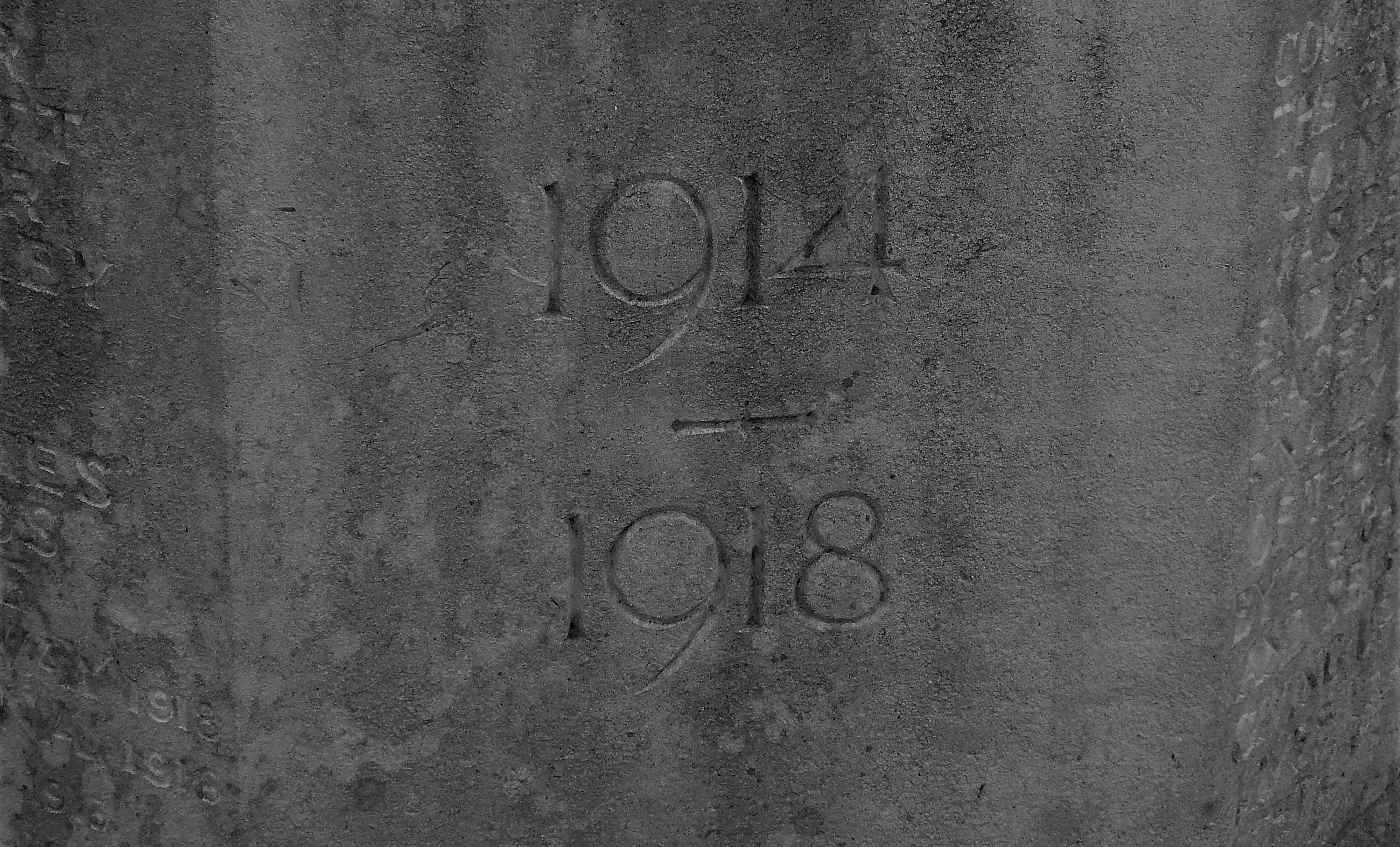
Dreamers by Siegfried Sassoon

Dreamers is one of Sassoon’s less well-known war poems. It was written in 1917, after he had made his declaration against the war and been sent to Craiglockhart hospital. It strongly evokes the contrast between the soldiers’ present day in the trenches, in which they seem to be already dead, and their imaginings of the past. It seems impossible for them to ever return to their former lives.

I wonder whether it might have been an influence on Philip Larkin’s MCMXIV (1914), published in 1964. The imagery of pre-war innocence is rather similar.

And although that imagery may be different now, there are volunteer soldiers out there, perhaps thinking rather similar thoughts as I write this.

Dreamers by Siegfried Sassoon

Soldiers are citizens of death’s grey land,
   Drawing no dividend from time’s to-morrows.
In the great hour of destiny they stand,
   Each with his feuds, and jealousies, and sorrows.
Soldiers are sworn to action; they must win
   Some flaming, fatal climax with their lives.
Soldiers are dreamers; when the guns begin
   They think of firelit homes, clean beds and wives.

I see them in foul dug-outs, gnawed by rats,
   And in the ruined trenches, lashed with rain,
Dreaming of things they did with balls and bats,
   And mocked by hopeless longing to regain
Bank-holidays, and picture shows, and spats,
   And going to the office in the train.

Grass by Carl Sandburg

I don’t think Carl Sandburg (1878–1967) is as widely read in the UK as he has been in his native United States. Perhaps his declamatory, free verse style is more of an American taste. I had never even heard of him when I saw this poem displayed in a tube train carriage as part of the Poems on the Underground initiative some years ago. I think it was published in 1918.

What brought it back into my mind more recently? I think it must have been an article about the Ukraine war that I read not long ago, illustrated with a photograph of a trench that could have come from the first world war.

Nothing changes, I thought and that is the message of this poem. War seems to be a permanent part of the human condition. People forget. They don’t like to think about it, so nothing changes. The personification of the grass in this straightforward and direct poem represents the process of forgetting.    

Grass by Carl Sandburg

Pile the bodies high at Austerlitz and Waterloo.
Shovel them under and let me work—
                                             I am the grass; I cover all.

And pile them high at Gettysburg
And pile them high at Ypres and Verdun.
Shovel them under and let me work.
Two years, ten years, and passengers ask the conductor:
                                            What place is this?
                                            Where are we now?

                                            I am the grass.
                                            Let me work.

Battle of Britain by C Day Lewis

DSCF3223 (2)

The skies over South East England have been quieter and emptier than we are used to of late. Eighty years ago they were full of warplanes as the Battle of Britain began.

This poem was written in 1970 by the then poet laureate, Cecil Day Lewis, for the thirtieth anniversary.

The big-budget cinematic re-enactment of the battle was released around that time, and if my memory is correct, this poem was printed in the programme for the film.

I like the way the narrator of the poem is a witness to the real events, speaking to someone younger for whom they are history. It deserves to be better known, I think.


Battle of Britain by C Day Lewis

What did we earth-bound make of it? A tangle
Of vapour trails, a vertiginously high
Swarming of midges, at most a fiery angel
Hurled out of heaven, was all we could descry.

How could we know the agony and pride
That scrawled those fading signatures up there,
And the cool expertise of those who died
Or lived through that delirium of the air?

Grounded on history now, we re-enact
Such lives, such deaths. Time, laughing out of court
The newspaper heroics and the faked
Statistics, leaves us only to record

What was, what might have been: fighter and bomber,
The tilting sky, tense moves and counterings;
Those who outlived that legendary summer;
Those who went down, its sunlight on their wings.

And you, unborn then, what will you make of it—
This shadow-play of battles long ago?
Be sure of this: they pushed to the uttermost limit
Their luck, skill, nerve. And they were young like you.


On A Return From Egypt by Keith Douglas

For obvious reasons, the celebrations for the 75th anniversary of VE day were a rather muted affair. It was a bit sad that the Red Arrows flypast became an event for television, rather than for real-life spectators.

One small gem did go ahead, though, the broadcast last night on Radio 3 of the play Unicorns, Almost by the poet Owen Sheers. It is a one-man piece about the second world war poet, Keith Douglas, played by Dan Krikler.

All the major poems, such as “How to Kill” and “Vergissmeinnicht” were included. If my memory is correct, the main biographical source was Douglas’s wartime memoir Alamein to Zem-Zem, with the words transposed to the present tense.

This had the effect of bringing Keith Douglas vividly to life, on the battlefield and in Alexandria, rather than leaving him as a figure dead on the pages of a history book.

The device of having Douglas speak after his death was very effective. It enabled Sheers to include the anecdote about Douglas’ mother finding all six copies of his Collected Poems unsold and unopened in her local bookshop, ten years after it had been published.

His reputation has risen slowly and steadily since then. References to his work crop up now and again. Alan Judd used a quote from Keith Douglas as the title for his novel A Breed of Heroes, and he appears as a character in Iain Gale’s novel Alamein.

Keith Douglas survived the battle of Alamein but was killed in action three days after D-Day. He was twenty-four years old.

The following poem was written in England before D-Day and published after his death.


On A Return From Egypt

To stand here in the wings of Europe
disheartened, I have come away
from the sick land where in the sun lay
the gentle sloe-eyed murderers
of themselves, exquisites under a curse;
here to exercise my depleted fury.

For the heart is a coal, growing colder
when jewelled cerulean seas change
into grey rocks, grey water-fringe,
sea and sky altering like a cloth
till colour and sheen are gone both:
cold is an opiate of the soldier.

And all my endeavours are unlucky explorers
come back, abandoning the expedition;
the specimens, the lilies of ambition
still spring in their climate, still unpicked:
but time, time is all I lacked
to find them, as the great collectors before me.

The next month, then, there is a window
and with a crash I’ll split the glass.
Behind it stands one I must kiss,
person of love or death
a person or a wraith,
I fear what I shall find.


A Private by Edward Thomas

DSCF3121 (5)

A poem by Edward Thomas, not so well known, but one of my favourites of his and appropriate for this week. Lest we forget and all that. . . .


This ploughman dead in battle slept out of doors
Many a frosty night, and merrily
Answered staid drinkers, good bedmen and all bores:
“At Mrs Greenland’s Hawthorn Bush,” said he,
“I slept.” None knew which bush. Above the town,
Beyond “The Drover”, a hundred spot the down
In Wiltshire. And where now at last he sleeps
More sound in France – that, too, he secret keeps.