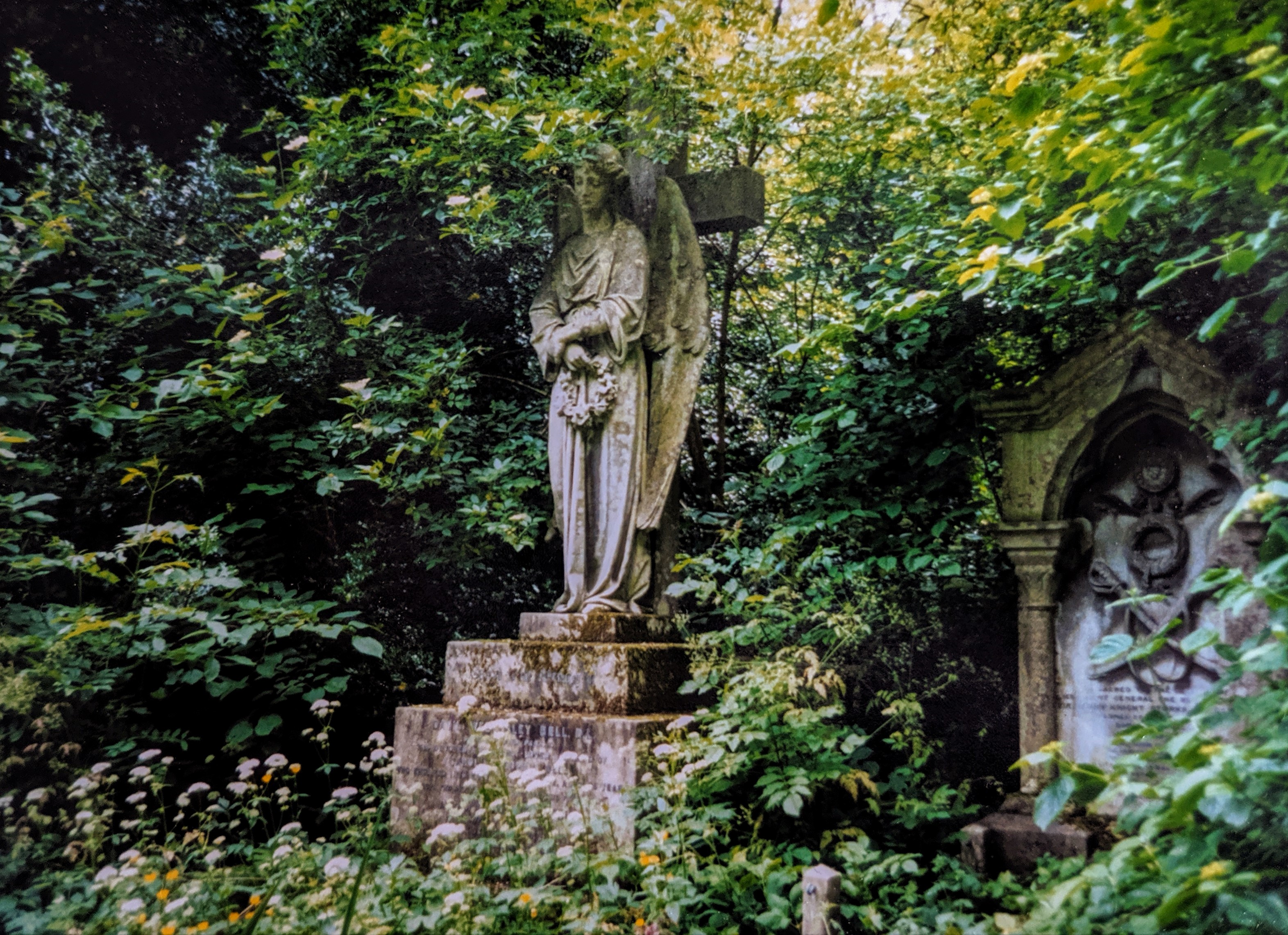
Memory by Walter de la Mare

It must be the sunny weather that made me think of the poem Memory by Walter de la Mare. It’s an appropriate one for the changing of the seasons. De la Mare wrote two poems with this title and this is the earlier one that was published in the 1933 collection, The Fleeting.

Perhaps it hints at that all too human tendency to wish oneself elsewhere. The last two lines tell us that De la Mare sees this as a positive thing. Memory enables us to live in our physical surroundings and the world of the imagination at one and the same time.

There is some archaic language in the second verse. “Nowel” is an alternative spelling of “Noel”, and “Waits” are carol singers. This part of the poem requires careful reading because the word order has been inverted in a slightly tricky way.

Memory by Walter de la Mare

When summer heat has drowsed the day
With blaze of noontide overhead,
And hidden greenfinch can but say
What but a moment since it said;
When harvest fields stand thick with wheat,
And wasp and bee slave—dawn till dark—
Nor home, till evening moonbeams beat,
Silvering the nightjar’s oaken bark:
How strangely then the mind may build
A magic world of wintry cold,
Its meadows with frail frost-flowers filled—
Bright-ribbed with ice, a frozen wold!. . .

When dusk shuts in the shortest day,
And dark Orion spans the night;
Where antlered fireflames leap and play
Chequering the walls with fitful light—
Even sweeter in mind the summer’s rose
May bloom again; her drifting swan
Resume her beauty; while rapture flows
Of birds long since to silence gone:
And though the Nowel, sharp and shrill,
Of Waits from out the snowbound street,
Drums to their fiddle beneath the hill
June’s mill-wheel where the waters meet. . .

O angel Memory that can
Double the joys of faithless Man!

Ding Dong Bell by Walter de la Mare

This small book of four linked short stories was published in 1924. Knowing that De la Mare wrote extensively for children, you would be forgiven from the title for thinking that this is a children’s book, but it is not. Before the first story, there is a selection of quotes from authors such as Shakespeare, Robert Burton and Thomas Browne. These are reflections on mortality and the passing of time, that set the tone and the theme for the stories to follow. I think the bell of the title is the passing bell.

Each story is set in a rural churchyard and features characters contemplating the inscriptions on the gravestones. These epitaphs and inscriptions are quoted in full, in italics within the stories. I assume that these were written in the traditional style by De la Mare himself, but there is no author’s note, so no way of telling if any of them were found in actual churchyards. Probably not, as they fit the stories so well. De la Mare showed his love of rhymes and verses of all sorts with his anthology Come Hither.

If this all sounds rather gloomy, it really isn’t. As so often with De la Mare, there is that nagging doubt about what has taken place that leaves the reader thinking about the story long after finishing it. Not that too much really does take place in these stories, they are as much meditations as descriptions of events.

In the first story, Lichen, a young woman waiting for a train at a country station passes the time by investigating the churchyard opposite in the company of a fellow passenger, a local old man. He is not an enthusiast of modern developments such as steam trains. “I see no virtue in mere size, or in mere rapidity of motion. Nor can I detect any particular preciousness in time ‘saved’, as you call it, merely to be wasted.” The story has something in common with De la Mare’s poem The Railway Junction. By the end the old man has become a “kind of King Canute by the sad sea waves of progress”.

In Benighted, a couple find themselves stranded in remote countryside and pass the warm summer night in a churchyard. Their reading of the inscriptions appears to have an implication for their future together and the story is presented as an episode in their past.

In Strangers and Pilgrims, the verger of an old church, who is accustomed to showing visitors around it, finds something unusual about his guest, dressed all in black, who is searching for a particular inscription. This is the longest and most complex of the four. Much of it is a conversation between the initially taciturn stranger and the talkative verger, on subjects such as the nature of the past and whether or not the dead can return. At the end there is still a mystery about the visitor’s identity.

For me, the last story, Winter, is the most effective. The narrator recounts his fleeting vision of an uncanny figure in a bleak and silent snowbound churchyard, an encounter that has stayed with him for years. “But such things are difficult to describe – to share. Date, year are, at any rate, of no account; if only for the reason that what impresses us most in life is independent of time. One can in memory indeed live over again events in one’s life even twenty years or more gone by, with the same fever of shame, anxiety, unrest. Mere time is nothing.” It is striking that the apparition is as put out to see the narrator as the narrator is to see him. Then there is the ambiguity of the figure’s final question: “Which is yours?”    

By the time the reader reaches this last story it has become apparent that the book is structured around the four seasons.

De la Mare’s way of writing about the countryside is quite unusual. It’s highly visual and evocative yet somehow slightly unreal at the same time, almost more intense than reality. You find yourself wondering where exactly such a place might actually be. It’s quite different to E F Benson, say, where you can identify the real place even when he doesn’t name it. It’s more akin to the kind of painting that offers a vision of the landscape rather than a directly realistic transcription of it.    

It was the description of the story Winter in the 2013 essay Ghosts in the Material World by the critic John Gray that set me on the path to explore De la Mare’s stories. I am so glad I did because I find something in his writing that I don’t find anywhere else.

I have already written about some of his other stories, such as The House and The Almond Tree in greater detail.

My 1936 edition of Ding Dong Bell comes with a quote from The Daily News that sums this book up rather well: “An odd, loveable little book, stamped with its author’s original imagination and filled with his haunting sense of wonder and beauty.”

The book also has what looks like a woodcut on the title page, that depicts the sort of scene found in the stories, but the artist is not credited.

Snow by Walter de la Mare

We finally got some snow yesterday. It was a welcome change from the lockdown to feel the crisp, crunchy snow under one’s feet.

Today, it’s a bright sunny day, almost with the promise of early spring in the air, and the snow has turned to treacherous ice on the pavement, or slush where it has melted. Will we see any more this winter?

There are several famous poems about snow or the winter more generally. I decided to go with this one, because I think it is less well-known than those by Thomas Hardy or Robert Bridges.

I’m not sure exactly when it was written; it is included in De la Mare’s 1944 Collected Rhymes and Verses. This is the collection intended for children. With De la Mare, though, the line between works for adults and works for children is always blurry. As he wrote in his introduction: “Somewhere the two streams divide — and may re-intermingle. Both, whatever the quality of the water, and of what it holds in solution, sprang from the same source”.  


Snow by Walter de la Mare

No breath of wind,
No gleam of sun —
Still the white snow
Whirls softly down —
Twig and bough
And blade and thorn
All in an icy
Quiet, forlorn.
Whispering, rustling,
Through the air,
On sill and stone,
Roof — everywhere,
It heaps its powdery
Crystal flakes,
Of every tree
A mountain makes;
Till pale and faint
At shut of day,
Stoops from the West
One wintry ray,
And, feathered in fire,
Where ghosts the moon,
A robin shrills
His lonely tune.

Walter de la Mare looks back at childhood

For many years, I avoided the writing of Walter de la Mare under the impression that he was a children’s author. He did write many poems and stories for children, but he also wrote for adults. In fact, his work rather blurs the distinction. The subtitle of his 1923 poetry anthology, Come Hither, makes this clear: “For the young of all ages”.

I suppose De la Mare is best known today for his adult short stories. These are often described as ghost stories, but the presence of the supernatural is so subtle and elusive, hinted at but barely seen, that they may disappoint those readers expecting something more conventionally spooky. You often finish a De la Mare story with a feeling of “what just happened there?”, but rather than being frustrating, this makes them all the more fascinating.

The Almond Tree is a story about a child written for adults. Indeed, it is a story about a child’s misunderstanding of the behaviour of the adults around him. It is not a ghost story, but shares the sense of mystery, the feeling that the explanation is there somewhere if only one could grasp it, that De la Mare’s ghost stories have.

As with a lot of De la Mare’s stores, it is quite difficult to convey the atmosphere of The Almond Tree. It is at first warmly nostalgic although it goes on to deal with a tragedy that is never fully explained.

The narrator is a man recalling his early childhood years as an only child at an isolated house in the deep countryside, with only adults for company. He observes his father’s absences from the household and feels the tension between his parents. He does not really understand that the lady his father introduces him to is his mistress.

As the situation worsens, so does the weather, and the climactic events of the story take place in a beautifully described wintry landscape.

Towards the end of the story, we realise what the boy has not understood – that his mother is pregnant. 

The main body of the story is framed by another narrative, that although short, is very important to our understanding of what has happened. Without giving too much away, there is a further twist. Two scraps of dialogue right at the end prompt us to think again and re-interpret some of what we have just read, and may possibly explain the source of the problems between the narrator’s parents.

De la Mare’s finely wrought prose style and narrative method do not make his work the easiest of reads. The reader has to do quite a lot of work, but for me the reward is worth the effort.

The Almond Tree gives you plenty to contemplate once you have laid it aside. Like other De la Mare stories, it reminds me quite strongly of the later stories of Rudyard Kipling, the ones that employ a similar method, where what is missing from the story, what is not said, is as important as what is said.

The Almond Tree was first published in 1923. I think it may have been quite influential on later writers, because I can see traces of it in Graham Greene’s story The Fallen Idol and L P Hartley’s novel The Go-Between.

There is an excellent 2010 BBC radio version of The Almond Tree, read by the actor Julian Wadham, whose voice suits the story perfectly. This was included in a series called Ghost Stories of Walter de la Mare, rather oddly.

If the above makes you think that De la Mare’s writing might be for you, I have also written about another of his stories, The House

Peace by Walter de la Mare

Remembrance Sunday is going to be a bit odd this year. The latest lockdown means that the familiar ceremonies at war memorials in towns and villages up and down the country will not now take place. We already knew that the ceremony at the Cenotaph in Whitehall was going to feature the politicians but not the public, and that there would be no march past. That seems a pity, as 2020 marks the centenary of the installation of the permanent memorial in Whitehall.

Here is a poem that does not fall into the usual definition of “first world war poetry”, as it was not written by a combatant and does not deal with life in the trenches. It was published in Walter de la Mare’s 1918 collection Motley.

De la Mare was already in his forties when he wrote it; how must he have felt twenty years later, when the peace he described was about to be shattered once again?  

Peace by Walter de la Mare

Night is o’er England, and the winds are still;
Jasmine and honeysuckle steep the air;
Softly the stars that are all Europe’s fill
Her heaven-wide dark with radiancy fair;
That shadowed moon now waxing in the west
Stirs not a rumour in her tranquil seas;
Mysterious sleep has lulled her heart to rest,
Deep even as theirs beneath her churchyard trees.

Secure, serene; dumb now the night-hawk’s threat;
The guns’ low thunder drumming o’er the tide;
The anguish pulsing in her stricken side….
All is at peace….But, never, heart, forget:
For this her youngest, best, and bravest died,
These bright dews once were mixed with bloody
      sweat.

The Belfry by Laurence Binyon

Like most people, I suppose, I knew Laurence Binyon for the famous lines from his 1914 poem For the Fallen: “They shall grow not old, as we that are left grow old/Age shall not weary them, nor the years condemn/At the going down of the sun and in the morning/We will remember them.”

The poem below is in a rather different vein and is completely new to me. I found it in Walter de la Mare’s wonderful anthology Come Hither, which has been a source of inspiration to me for some time now, as it’s full of exactly the sort of poetry I like. The Belfry is rather reminiscent of the style of de la Mare’s own poetry, I feel. It really comes to life if you read it aloud. I don’t know exactly when it was written.

I think it also appeals to me, partly because I too had the childhood experience of climbing up inside an ancient church tower.


The Belfry

Dark is the stair, and humid the old walls
Wherein it winds, on worn stones, up the tower.
Only by loophole chinks at intervals
Pierces the late glow of this August hour.

Two truant children climb the stairway dark,
With joined hands, half in glee and half in fear,
The boy mounts brisk, the girl hangs back to hark
If the gruff sexton their light footstep hear.

Dazzled at last they gain the belfry-room.
Barred rays through shutters hover across the floor
Dancing in dust; so fresh they come from gloom
That breathless they pause wondering at the door.

How hushed it is! What smell of timbers old
From cobwebbed beams! The warm light here and there
Edging a darkness, sleeps in pools of gold,
Or weaves fantastic shadows through the air.

How motionless the huge bell! Straight and stiff,
Ropes through the floor rise to the rafters dim.
The shadowy round of metal hangs, as if
No force could ever lift its gleamy rim.

A child’s awe, a child’s wonder, who shall trace
What dumb thoughts on its waxen softness write
In such a spell-brimmed, time-forgotten place,
Bright in that strangeness of approaching night?

As these two gaze, their fingers tighter press;
For suddenly the slow bell upward heaves
Its vast mouth, the cords quiver at the stress,
And ere the heart prepare, the ear receives

Full on its delicate sense the plangent stroke
Of violent, iron, reverberating sound.
As if the tower in all its stones awoke,
Deep echoes tremble, again in clangour drowned,

That starts without a whir of frighted wings
And holds these young hearts shaken, hushed, and thrilled,
Like frail reeds in a rushing stream, like strings
Of music, or like trees with tempest filled,

And rolls in wide waves out o’er the lone land,
Tone following tone toward the far-setting sun,
Till where in fields long-shadowed reapers stand
Bowed heads look up, and lo, the day is done. . . .


The House by Walter de la Mare


CNV00012 (2)

At the beginning of Walter de la Mare’s story The House, a tired and elderly man arrives back at his house in the country, late at night. We learn that he is to leave the house for the last time in the morning. Two female servants, the only other occupants, have already left. During the night, the man, who we know only as Mr Asprey, goes on a final tour of the house, where he has lived all his life, it seems. Rooms contain memories, regrets…or are they ghosts of some sort?

He sees himself as an unhappy small boy. The room that used to be his parents’ summons up a vision of his father’s grave. A portrait of a woman reminds him that he never declared his love to her.

As he goes round he makes careful notes of things to do. But these are major things, such as leaving an heir to inherit the house. It is as if he is making an inventory of his regrets, the things left undone in life.

There is an odd atmosphere, and the reader begins to wonder. Is the man actually alive? Is all this taking place in some mysterious zone between life and death? Is it a real house or a symbolic one, representing the man’s life or personality?

He ponders a manuscript, given to him by a friend for a critical appraisal; he had not read it when his friend died suddenly and he never returned it to the friend’s wife.

In the kitchen, he finds a wallet hidden in a drawer. It was presumed stolen by one of his servants many years before and led to her dismissal. When he turns round, the wronged servant is sitting at the table. He hands the wallet to the woman. Then she disappears, taking the wallet, which he had assumed to be real, with her. We are on the borderline between the physical and the insubstantial here.

He accidentally spills a pot of coffee over the list he has so carefully compiled, making it illegible, with no time left to write another one.

He is expecting some kind of “conveyance” to come for him in the morning. But finally, he steps through the front door into an “infinite waste of wasteless light”, and the door closes by itself behind him. He seems to be in another world, but one that is familiar to him. If this is death it feels like an awakening. “It looked as if he must be intended to walk. And so he set out.” So ends a story that will linger long in the reader’s mind.

I can give only the merest flavour of this extraordinary story. It is difficult to do it justice. It think it is connected in some way to De la Mare’s poem The Railway Junction, which was published around the same time, the mid-1930s, I think, and has similar symbolic undertones.

De la Mare relies on elusiveness and ambiguity. There is often a dreamlike mood in his atmospheric stories, written with the precision of language we would expect from such an accomplished poet. Here, as in so many of his stories, we are not quite sure  exactly what has happened. The effect is a bit like watching a film where something might or might not be glimpsed at the corner of the screen. Each reading of a De la Mare story can reveal a new emphasis or meaning. They almost demand to be read more than once, but the reader will find it hard to settle on one fixed, solid interpretation.

De la Mare’s stories have rather gone out of fashion, but there are signs that interest in his work is reviving. A selection was published by the British Library not long ago. They are often categorised as “ghost stories” and compared to the work of Henry James in this field. Certainly, the subtle, shifting atmosphere so characteristic of De la Mare is closer to Henry James than M R James, but also similar to the later stories of Rudyard Kipling.

Another reason for the comparative neglect of these stories might be that whereas M R James’ ghost stories were collected into one volume which has stayed consistently in print, De la Mare’s were spread over several different collections. There is not even general agreement as to which of his many short stories should be considered as “supernatural” or “ghost” stories.

There is an excellent BBC radio series of readings of five De la Mare tales. It turns up on Radio 4 extra from time to time or can be found on YouTube. The House, alas, is not one of the stories featured.

Ten of the best ghost stories

Highgate Cemetery OLD (2)

M R James called them “Ghost Stories”; E F Benson preferred the term “Spook Stories”; H P Lovecraft’s stories were published in the magazine Weird Tales; Robert Aickman called his productions “Strange Stories”. Dave Allen’s 1970s anthology was called A Little Night Reading. Whatever we call them, we know what we are talking about.

The Dave Allen book was in our local library when I was young. I’ve often wished I was in the position to choose the stories for such an anthology myself. Here, then, in no particular order and in time for Halloween, is my selection of ten pretty good ones.

The Monkey’s Paw by W W Jacobs (1902). Three wishes that lead to tragedy. It’s impossible to read the last few words of this tale without that feeling of a shiver up the spine, no matter how many times you have read it before. Be careful what you wish for, in case you get it, indeed.

The Signalman by Charles Dickens (1866). No other form of transport has featured in as many ghost stories as the railway. This is a story of premonition and disaster that Dickens wrote after being involved in a major train crash himself. I’ve looked at it in more detail here.

A Warning to the Curious by M R James (1925). I could have picked any one of half a dozen stories by James, but this one wins out, I think, for the East Anglian coastal setting and the feeling that it is something to do with the recent war. The framing narration makes Seaburgh remote in time as well as place, then the second narrator introduces a note of melancholy, as he casually mentions his dead friend. Nowhere else is the characteristic James atmosphere so strong, that feeling of the light fading on a deserted beach on a late November afternoon.

The Music of Eric Zann by H P Lovecraft (1922). I am not altogether a fan of Lovecraft. I tend to think of him as a writer I enjoyed in my teenage years, then left behind. All those slug or wormlike monsters! Too easy to dismiss as things that do not exist. This one, though, is quite different. Paris by night and strange violin music coming from the garret at the top of the stairs. . . .what can one see from the window?

A Small Place off the Edgware Road by Graham Greene (1947). The place in question is a cinema. This is very creepy and all it is, really, is a chat between neighbours in cinema seats. It’s an all too believable tale of the incursion of the uncanny into the everyday world that I think may show the influence of Walter de la Mare.

Naboth’s Vineyard by E F Benson (1928). Just as with M R James, I could have picked any one of half a dozen by Benson. In fact, his range was a bit wider than James. Some are very English ghost stories, with clearly recognisable coastal settings, whereas others lean closer to the Lovecraft style. As I have written about Pirates elsewhere, for this selection I’ll go for another favourite. Here is a very satisfying tale of property appropriated and revenge from beyond the grave. It couldn’t happen to a nicer fellow. . . .

Bad Company by Walter de la Mare (1955). De la Mare’s ghost stories are not so well known today. He is a master of doubt and ambiguity, close to the psychological style of Henry James. Again, one is spoilt for choice, but this short tale has stuck in my mind. London by night this time, and a reminder of why it doesn’t pay to look too closely at your fellow passengers on the tube. A strange encounter in the underground, followed by a lonely walk through a cold and deserted city to an empty house.

Man Size in Marble by E Nesbit (1893). Like De la Mare, Edith Nesbit is best-known today as a writer for children. I found this in the same anthology of ghost stories for children as the De la Mare one above. All I can say is, it must have been for children with strong nerves. The idyllic early days of a marriage between two artists, a cottage deep in the countryside. What could go wrong? There is a local legend that once a year, the stone effigies in the nearby church are able to walk. . . on Halloween, of course.

Ringing the Changes by Robert Aickman (1964). We are in East Anglia again, that zone of the uncanny, and this is a sort of zombie story, with elements of what is now known as folk horror. What makes it so fascinating, I think, is the relation of the main story about zombies to the second layer of meaning bubbling away under the surface, about the marriage of an older man to a much younger woman.

‘They’ by Rudyard Kipling (1904). This may be a surprise to those whose image of Kipling comes from The Jungle Book and poems of the army and empire. Many of his stories have a supernatural element, and none more so than this one. When the narrator discovers an ancient house, hidden in the Sussex countryside, he catches fleeting glimpses of children at the windows and in the garden. A blind woman holds the key to the mystery. It is made all the more poignant when you realise it was written after the death of Kipling’s own small daughter, and that the house resembles Bateman’s, Kipling’s Sussex home.

I’m aware that I’ve skipped over the surface a bit here, but my intention is to whet your appetite. All these stories have hidden depths that will repay repeated readings. Perhaps the secret of a really good story of this type is that it can be given more than one interpretation.  There are many others. Which ones would you choose?