Mrs Bathurst by Rudyard Kipling

Rudyard Kipling’s story Mrs Bathurst was published in 1904 and reveals Kipling as a rather more modern writer than he is usually considered to be.

The plot makes use of the cinema and it may well be the first piece of fiction to do so. The fractured style of the story may be modelled on the cinema, rather in the way that one can see the early poetry of T S Eliot making use of cinematic imagery.  

The term “It” to describe a woman’s appeal to men appears here, a usage that Kipling is thought to have invented, to go alongside the many phrases he added to the language. What makes the story feel modern is the way it is told and it may be that part of what Kipling is telling us here is the impossibility of ever really knowing anyone else.

On the South African coast, just after the Boer war, the narrator is sitting and talking to his railwayman friend, Hooper. They are then joined by a royal marine, Pritchard, and a sailor, Petty Officer Pyecroft, who is a recurring Kipling character. At first the story seems to be going nowhere, as the four men chat about the idea of going absent without leave, as opposed to desertion.

But as the tale progresses, the first-person narrative gives way to dialogue. The narrator is merely a convenient device to set the scene for the anecdote that follows. There is no authorial voice or viewpoint. The tale is told in a fragmented way, mostly by Pyecroft, who does not quite understand the events he is recounting. As he says “all I know is second-hand so to speak” and there is no help given to the reader to interpret any of this.

He tells of his shipmate Vickery’s obsession with a Mrs Bathurst who kept a small hotel for sailors in Auckland, New Zealand. It’s never made clear exactly what the relationship between Vickery and Mrs Bathurst might have been in the past. The marine, Pritchard, is also familiar with her and the hotel and he describes to the others what she is like.

The finale with its striking visual image of two charred corpses is provided by Hooper, who has dropped hints about this earlier in the tale. One body can only be identified by false teeth and a tattoo, and the identity of the other remains a mystery. Different parts of the story have been told by Pyecroft, Hooper and Pritchard, who were more witnesses to events than participants, and the reader must piece it all together as best they can. Everything has been seen from the outside.

Not every question raised by the story is answered at the end. What exactly took place in the meeting between Vickery and the captain of his ship before he was sent ashore? And at the very end it appears that Hooper is going to remove the false teeth from his pocket but thinks better of it.    

The use of the film image of Mrs Bathurst herself is very interesting. It’s mentioned that someone in the audience jumps when they see the image of the train pulling into the station. Was Kipling familiar with the story about the audience reaction to the Lumiere Brothers’ first showing of their film or was this the true source of it?

There is also the question of just why Vickery is so obsessed with the film of Mrs Bathurst. He thinks it was taken in London, gets drunk after seeing it, then insists on going back to see it again four nights in a row, with Pyecroft in tow to confirm that it is indeed her on the screen. It has been suggested by Dr Oliver Tearle that Mrs Bathurst is dead. There are hints in the story that this may be so. That interpretation would make it a sort of ghost story. On the other hand, it is very difficult now when we are surrounded by moving images of people both alive and dead, to feel the impact that early films made on their first audiences.

However one reads it, this is certainly one of Kipling’s most cryptic tales. In his memoirs he wrote about his method of writing, which was to cut, lay the story aside for a while then go back to it and cut some more. He considered that what had been cut would have a lingering influence on the words that remained. One can see how this story might have been written in that way.

Rather ironically perhaps, there is no known surviving film footage or audio recording of Rudyard Kipling himself.

The Haunting of Lamb House by Joan Aiken

The Haunting of Lamb House by Joan Aiken is a novel published in 1991. Lamb House, a Georgian building in Rye, Sussex, has been home to several writers over the years. Henry James lived and wrote there, as did E F Benson and later on, Rumer Godden. James wrote The Turn of the Screw there; Benson wrote his Mapp and Lucia novels, in which the house itself features, as well as many ghost stories there. It is now a National Trust property. Joan Aiken was born in Rye and lived not far away all her life.

This is an atmospheric and fascinating novel, an intriguing mixture of fact and fiction. It is composed of three linked stories. In the first, Toby Lamb, son of the builder of the house, tells the tale of tragic events in his childhood and youth. This is a very credible recreation of life in early eighteenth-century Sussex. We find out towards the end that what we have been reading is his own manuscript, written later in life, which he conceals behind a wall in the house.

Many years later, Henry James becomes the occupant of the house. This story is written in the third person in a style rather like James’ own. He feels as if the house has chosen him, rather than the other way round. A mysterious fire leads to some reconstruction work and the discovery of the manuscript. There are troubling similarities between Toby’s story and James’ own life. James considers publishing the manuscript as it is, but his brother William dissuades him. James considers that Toby’s use of the first-person style is a weakness and he re-writes it. He shows his new version to his friend and fellow-writer Edith Wharton. She considers that the work is not up to his usual standard.

After James’ death the house passes to E F Benson. He too has the feeling that the house is calling to him in some way. This story is the shortest of the three, written in the first person in the style of one of Benson’s ghost stories. Behind a garden wall he discovers another secret garden in which he erects a writing hut. It is while writing there that he sees the apparition of a man in black, a figure who featured in the first story, when Toby saw him in the garden. I shall not spoil things by saying who he is. A meeting across time resolves things in a satisfying way but also with a suggestion that the cycle will carry on when Benson says: “Perhaps you and I, Hugh, will be the next pair of ghosts to take over the lease. Perhaps we shall be occupying the secret garden here in the year 2030!”

This is as much a meditation on ideas of literary quality and posterity as a conventional ghost story. James is disconcerted by the fact that Edith Wharton’s novels sell so much better than his own, which he considers to be of higher quality. Benson is aware that although his own novels are successful, they do not really go deep enough.

Joan Aiken’s reader’s note is slightly misleading, perhaps deliberately so. She says that Toby’s story is completely fictional, yet elements of it, such as the visit of King George, are part of the history of Rye. She acknowledges that she has drawn on writings by and about James and Benson for their stories. She says that the ghosts are entirely fictional. What she does not say is that the description of the man in black is taken almost word-for-word from E F Benson’s 1940 autobiography, in which he describes an encounter with what he took to be a ghost.

How much you like this novel will probably depend on how much you like the writing of Henry James and E F Benson and whether or not you have been to Rye. For an admirer of E F Benson’s ghost stories like me, it’s a real treat. I have the feeling that there’s been something of a competition over the years as to whether Lamb House should be a literary shrine to James or to Benson. I know James is generally considered the superior writer, but Benson wrote not only in the house but about the house, so for me that secures his claim to it. After all, he lived there much longer than James, from 1918 until his death in 1940.

I have also written about E F Benson’s stories The Temple and Pirates.

Ding Dong Bell by Walter de la Mare

This small book of four linked short stories was published in 1924. Knowing that De la Mare wrote extensively for children, you would be forgiven from the title for thinking that this is a children’s book, but it is not. Before the first story, there is a selection of quotes from authors such as Shakespeare, Robert Burton and Thomas Browne. These are reflections on mortality and the passing of time, that set the tone and the theme for the stories to follow. I think the bell of the title is the passing bell.

Each story is set in a rural churchyard and features characters contemplating the inscriptions on the gravestones. These epitaphs and inscriptions are quoted in full, in italics within the stories. I assume that these were written in the traditional style by De la Mare himself, but there is no author’s note, so no way of telling if any of them were found in actual churchyards. Probably not, as they fit the stories so well. De la Mare showed his love of rhymes and verses of all sorts with his anthology Come Hither.

If this all sounds rather gloomy, it really isn’t. As so often with De la Mare, there is that nagging doubt about what has taken place that leaves the reader thinking about the story long after finishing it. Not that too much really does take place in these stories, they are as much meditations as descriptions of events.

In the first story, Lichen, a young woman waiting for a train at a country station passes the time by investigating the churchyard opposite in the company of a fellow passenger, a local old man. He is not an enthusiast of modern developments such as steam trains. “I see no virtue in mere size, or in mere rapidity of motion. Nor can I detect any particular preciousness in time ‘saved’, as you call it, merely to be wasted.” The story has something in common with De la Mare’s poem The Railway Junction. By the end the old man has become a “kind of King Canute by the sad sea waves of progress”.

In Benighted, a couple find themselves stranded in remote countryside and pass the warm summer night in a churchyard. Their reading of the inscriptions appears to have an implication for their future together and the story is presented as an episode in their past.

In Strangers and Pilgrims, the verger of an old church, who is accustomed to showing visitors around it, finds something unusual about his guest, dressed all in black, who is searching for a particular inscription. This is the longest and most complex of the four. Much of it is a conversation between the initially taciturn stranger and the talkative verger, on subjects such as the nature of the past and whether or not the dead can return. At the end there is still a mystery about the visitor’s identity.

For me, the last story, Winter, is the most effective. The narrator recounts his fleeting vision of an uncanny figure in a bleak and silent snowbound churchyard, an encounter that has stayed with him for years. “But such things are difficult to describe – to share. Date, year are, at any rate, of no account; if only for the reason that what impresses us most in life is independent of time. One can in memory indeed live over again events in one’s life even twenty years or more gone by, with the same fever of shame, anxiety, unrest. Mere time is nothing.” It is striking that the apparition is as put out to see the narrator as the narrator is to see him. Then there is the ambiguity of the figure’s final question: “Which is yours?”    

By the time the reader reaches this last story it has become apparent that the book is structured around the four seasons.

De la Mare’s way of writing about the countryside is quite unusual. It’s highly visual and evocative yet somehow slightly unreal at the same time, almost more intense than reality. You find yourself wondering where exactly such a place might actually be. It’s quite different to E F Benson, say, where you can identify the real place even when he doesn’t name it. It’s more akin to the kind of painting that offers a vision of the landscape rather than a directly realistic transcription of it.    

It was the description of the story Winter in the 2013 essay Ghosts in the Material World by the critic John Gray that set me on the path to explore De la Mare’s stories. I am so glad I did because I find something in his writing that I don’t find anywhere else.

I have already written about some of his other stories, such as The House and The Almond Tree in greater detail.

My 1936 edition of Ding Dong Bell comes with a quote from The Daily News that sums this book up rather well: “An odd, loveable little book, stamped with its author’s original imagination and filled with his haunting sense of wonder and beauty.”

The book also has what looks like a woodcut on the title page, that depicts the sort of scene found in the stories, but the artist is not credited.

An Evening’s Entertainment by M R James

An Evening’s Entertainment is one of the less well-known ghost stories by M R James. It appeared in his 1925 collection A Warning to the Curious and Other Stories. The main character in a James story is often a fusty academic type, a sort of exaggerated version of himself. That is the general image of his work, but it obscures the fact that the range of characters and settings in his stories is actually rather wider than that.

Here, a James-style narrator opens the story and laments the fact that the old story books are not very specific about ghosts or folklore. He then goes on to imagine how a grandmother might tell a spooky story to the grandchildren in front of the fire before bed, hence the title. The story is indeed, in a phrase that appears early on, “a pleasing terror”.

One of the children has picked blackberries from a lane that the grandmother was told to avoid by her grandmother. Why is there a clump of fruit bushes in the lane? Because there was a cottage there once, which was the site of strange goings-on. It was inhabited by a man who didn’t work and didn’t mix much in the village. One day he brought an odd young man back to live with him. The pair were often seen out and about at all hours in the woods and on the downs above the village.

On the downs there is a human figure carved into the landscape, and many ancient burial mounds. Something the young man lets slip in a conversation suggests that on their nocturnal jaunts there, this unlikely pair are not alone. They seem to be familiar with the appearance of the people who lived there before the Romans.

This is just the beginning of a series of gruesome events, involving pagan worship, violent death, burial at a crossroads and the “lord of flies”, events long remembered in the village giving the patch of ground in the lane its bad reputation.

There are only two carved human figures in England, the Long Man of Wilmington in Sussex and the Cerne Abbas Giant in Dorset. I wonder which one James had in mind? Something about this story suggests Sussex to me, perhaps the fact that the figure is referred to as “the old man on the hill”.

James wrote in the preface to his collected ghost stories that he had tried to make his ghosts “act in ways not inconsistent with the rules of folklore”. This particular story is almost the definitive expression of what has come to be known as “folk horror”. It shows, like many of his other tales, that James was particularly skilled at evoking the feel of the English landscape. It rather reminds me of John Masefield’s poem Up on the Downs. I also wonder whether it might have been an influence on Jocelyn Brooke and The Image of a Drawn Sword.  

Walter de la Mare looks back at childhood

For many years, I avoided the writing of Walter de la Mare under the impression that he was a children’s author. He did write many poems and stories for children, but he also wrote for adults. In fact, his work rather blurs the distinction. The subtitle of his 1923 poetry anthology, Come Hither, makes this clear: “For the young of all ages”.

I suppose De la Mare is best known today for his adult short stories. These are often described as ghost stories, but the presence of the supernatural is so subtle and elusive, hinted at but barely seen, that they may disappoint those readers expecting something more conventionally spooky. You often finish a De la Mare story with a feeling of “what just happened there?”, but rather than being frustrating, this makes them all the more fascinating.

The Almond Tree is a story about a child written for adults. Indeed, it is a story about a child’s misunderstanding of the behaviour of the adults around him. It is not a ghost story, but shares the sense of mystery, the feeling that the explanation is there somewhere if only one could grasp it, that De la Mare’s ghost stories have.

As with a lot of De la Mare’s stores, it is quite difficult to convey the atmosphere of The Almond Tree. It is at first warmly nostalgic although it goes on to deal with a tragedy that is never fully explained.

The narrator is a man recalling his early childhood years as an only child at an isolated house in the deep countryside, with only adults for company. He observes his father’s absences from the household and feels the tension between his parents. He does not really understand that the lady his father introduces him to is his mistress.

As the situation worsens, so does the weather, and the climactic events of the story take place in a beautifully described wintry landscape.

Towards the end of the story, we realise what the boy has not understood – that his mother is pregnant. 

The main body of the story is framed by another narrative, that although short, is very important to our understanding of what has happened. Without giving too much away, there is a further twist. Two scraps of dialogue right at the end prompt us to think again and re-interpret some of what we have just read, and may possibly explain the source of the problems between the narrator’s parents.

De la Mare’s finely wrought prose style and narrative method do not make his work the easiest of reads. The reader has to do quite a lot of work, but for me the reward is worth the effort.

The Almond Tree gives you plenty to contemplate once you have laid it aside. Like other De la Mare stories, it reminds me quite strongly of the later stories of Rudyard Kipling, the ones that employ a similar method, where what is missing from the story, what is not said, is as important as what is said.

The Almond Tree was first published in 1923. I think it may have been quite influential on later writers, because I can see traces of it in Graham Greene’s story The Fallen Idol and L P Hartley’s novel The Go-Between.

There is an excellent 2010 BBC radio version of The Almond Tree, read by the actor Julian Wadham, whose voice suits the story perfectly. This was included in a series called Ghost Stories of Walter de la Mare, rather oddly.

If the above makes you think that De la Mare’s writing might be for you, I have also written about another of his stories, The House

Corporal Stare by Robert Graves

Following on from my previous post, it appears that Remembrance Day events will now be allowed to go ahead this coming Sunday, as long as they are outdoors and follow social distancing rules. Don’t they usually take place outdoors anyway? I suppose the point is that no church services can take place.

So here is another poem from one of the poets most closely associated with the first world war. It was written in 1917. Graves later gave a more detailed account of the real life incident that inspired the poem in his famous prose memoir, Goodbye to All That. He writes there: “Ghosts were numerous in France at that time”.

Corporal Stare by Robert Graves

Back from the line one night in June,
I gave a dinner at Bethune —
Seven courses, the most gorgeous meal
Money could buy or batman steal.
Five hungry lads welcomed the fish
With shouts that nearly cracked the dish;
Asparagus came with tender tops,
Strawberries in cream, and mutton chops.
Said Jenkins, as my hand he shook,
“They’ll put this in the history book.”
We bawled Church anthems in choro
Of Bethlehem and Hermon snow,
With drinking songs, a jolly sound
To help the good red Pommard round.
Stories and laughter interspersed,
We drowned a long La Bassée thirst —
Trenches in June make throats damned dry.
Then through the window suddenly,
Badge, stripes and medals all complete,
We saw him swagger up the street,
Just like a live man — Corporal Stare!
Stare! Killed last May at Festubert.
Caught on patrol near the Boche wire,
Torn horribly by machine-gun fire!
He paused, saluted smartly, grinned,
Then passed away like a puff of wind,
Leaving us blank astonishment.
The song broke, up we started, leant
Out of the window-nothing there,
Not the least shadow of Corporal Stare,
Only a quiver of smoke that showed
A fag-end dropped on the silent road.

The Temple by E F Benson

The Temple by E F Benson was published in a magazine in 1924, and later collected in the volume Spook Stories in 1928. It begins, as so often with Benson, with two youngish, well-off bachelors deciding to take an extended holiday in a pleasant part of the country. It is Cornwall this time, and the two men are soon installed in a large seaside hotel, with its own golf links between the beach and the hotel grounds.

The narrator is a writer and his companion is an archaeologist who plans to investigate some of the antiquities of the county. The local people are superstitious about a nearby stone circle, believing it to be a pagan temple. The archaeologist says it can’t be, because the arrangement of the stones is wrong, but more importantly, it lacks a sacrificial stone in the centre. He is sure there must be a temple site somewhere in the neighbourhood and he is determined to find it.

Later, the two men are aware of an ominous atmosphere while walking in a wood: “. . . I was conscious of some gathering oppression of the spirit. It was an uncomfortable place, it seemed thick with unseen presences.” They think nothing of it, emerging back into the sunshine to come across a pretty cottage that appears to be uninhabited. The hotel is beginning to fill up for the season. Would it be possible to stay in the cottage instead? Enquiries are made and the cottage is indeed available at a knock-down price because the previous occupant committed suicide.

The wood on the hill overlooks the cottage. What are the lights that can be seen moving about in it at night? And just what is the large stone that forms part of the kitchen floor of the cottage?

It turns out that the cottage has been built in the centre of the pagan temple, with disastrous consequences. This is not entirely a surprise to the reader, and as I’ve said before, it’s not really suspense that is the appeal of a Benson story, but the sense of inexorable progress towards a malign fate that cannot be avoided.

He also has a wonderful gift for conveying the sense of place in his elegant, precise prose. His stories are often set in a remote part of the English countryside, with a local large town, such as Hastings, often given its real name but the village or hamlet where the action takes place given a fictional name, allowing Benson some room for invention.

The Temple fits neatly into the genre that is today known as Folk Horror. The central idea is also not as far-fetched as it might appear. After all, something similar happened at Avebury in Wiltshire, where the stones of the circle were knocked down in the eighteenth century and used to build houses in the village that grew up inside it. I suspect Benson might have been inspired by the restoration at Avebury that was beginning at around the time he wrote his story.

I’ve also written about Pirates, another tale by Benson.

The House by Walter de la Mare


CNV00012 (2)

At the beginning of Walter de la Mare’s story The House, a tired and elderly man arrives back at his house in the country, late at night. We learn that he is to leave the house for the last time in the morning. Two female servants, the only other occupants, have already left. During the night, the man, who we know only as Mr Asprey, goes on a final tour of the house, where he has lived all his life, it seems. Rooms contain memories, regrets…or are they ghosts of some sort?

He sees himself as an unhappy small boy. The room that used to be his parents’ summons up a vision of his father’s grave. A portrait of a woman reminds him that he never declared his love to her.

As he goes round he makes careful notes of things to do. But these are major things, such as leaving an heir to inherit the house. It is as if he is making an inventory of his regrets, the things left undone in life.

There is an odd atmosphere, and the reader begins to wonder. Is the man actually alive? Is all this taking place in some mysterious zone between life and death? Is it a real house or a symbolic one, representing the man’s life or personality?

He ponders a manuscript, given to him by a friend for a critical appraisal; he had not read it when his friend died suddenly and he never returned it to the friend’s wife.

In the kitchen, he finds a wallet hidden in a drawer. It was presumed stolen by one of his servants many years before and led to her dismissal. When he turns round, the wronged servant is sitting at the table. He hands the wallet to the woman. Then she disappears, taking the wallet, which he had assumed to be real, with her. We are on the borderline between the physical and the insubstantial here.

He accidentally spills a pot of coffee over the list he has so carefully compiled, making it illegible, with no time left to write another one.

He is expecting some kind of “conveyance” to come for him in the morning. But finally, he steps through the front door into an “infinite waste of wasteless light”, and the door closes by itself behind him. He seems to be in another world, but one that is familiar to him. If this is death it feels like an awakening. “It looked as if he must be intended to walk. And so he set out.” So ends a story that will linger long in the reader’s mind.

I can give only the merest flavour of this extraordinary story. It is difficult to do it justice. It think it is connected in some way to De la Mare’s poem The Railway Junction, which was published around the same time, the mid-1930s, I think, and has similar symbolic undertones.

De la Mare relies on elusiveness and ambiguity. There is often a dreamlike mood in his atmospheric stories, written with the precision of language we would expect from such an accomplished poet. Here, as in so many of his stories, we are not quite sure  exactly what has happened. The effect is a bit like watching a film where something might or might not be glimpsed at the corner of the screen. Each reading of a De la Mare story can reveal a new emphasis or meaning. They almost demand to be read more than once, but the reader will find it hard to settle on one fixed, solid interpretation.

De la Mare’s stories have rather gone out of fashion, but there are signs that interest in his work is reviving. A selection was published by the British Library not long ago. They are often categorised as “ghost stories” and compared to the work of Henry James in this field. Certainly, the subtle, shifting atmosphere so characteristic of De la Mare is closer to Henry James than M R James, but also similar to the later stories of Rudyard Kipling.

Another reason for the comparative neglect of these stories might be that whereas M R James’ ghost stories were collected into one volume which has stayed consistently in print, De la Mare’s were spread over several different collections. There is not even general agreement as to which of his many short stories should be considered as “supernatural” or “ghost” stories.

There is an excellent BBC radio series of readings of five De la Mare tales. It turns up on Radio 4 extra from time to time or can be found on YouTube. The House, alas, is not one of the stories featured.

Don’t Look Now: great story, great film

Memory is a funny thing. I know this happened but I’m not sure exactly when and the details are hazy. Our local cinema used to have late-night screenings on a Friday night. Not the latest releases, but what you might call cult classics, in the days before they were available on video. We are talking about the mid to late seventies here.

One Friday after the pub we trooped along to see a Nicolas Roeg double bill, attracted by the prospect of David Bowie in The Man Who Fell to Earth. That was on first, so it must have been well after midnight when the second film started. I had heard of Don’t Look Now, but I didn’t know much about it, except that it was adapted from a story by Daphne du Maurier, known to me as the author of Rebecca.

I have never seen any other film that generates such a sense of unease and dread. Even something seemingly innocuous, the interview at the  police station, is full of. . . well, what exactly? The same feeling that runs through the whole story, that there is something you can’t quite grasp, out of reach, until everything that seemed fragmentary is connected horrifically and tragically at the end.

They used to turn the heating off, so imagine watching those scenes of a dank and wintry Venice in a cold cinema. Then think of the ending and imagine walking home in the early hours of the morning after that. I would never forget this chilling story of bereavement and second sight.

I have seen it several times since on the television, and I have read Daphne du Maurier’s story more than once. It’s fascinating to compare the story and the film. It’s only fifty pages or so, a longish short story, but too short to be called a novella.

The prologue in England was added for the film, but what Roeg also did was to take the story and make it more visual, as you would expect, by creating the repeated images of the colour red, water and breaking glass. The colour red was something of a theme with Roeg in his earlier films as director of photography, such as Fahrenheit 451 and Far From The Madding Crowd.

Something that could not really be transferred to the screen was the fact that the viewpoint character is the man. Thus we have a female writer looking critically at a woman through the eyes of a man. Also, the film was set roughly contemporary to when it was made, in 1973. In the story, there are indications that it is set a bit further back, in the nineteen-fifties, say. The fame of the film has rather overshadowed the story, but I feel that although they are distinct works in their own right, it should always be remembered that the original ideas that drive the film came from the fertile imagination of Daphne du Maurier.

Du Maurier was a favourite writer of my parents. My mother was particularly fond of the novel The King’s General. There was always a bit of a problem with Du Maurier’s reputation in that, for all her fame and success, she was regarded as a writer of “romance” or “women’s fiction”. That probably put me off reading her work when I was younger. Don’t Look Now and the other short stories place her in quite different territory, much closer to Patricia Highsmith or Shirley Jackson who were her true peers, rather than Georgette Heyer, say.

Around the time of the centenary of du Maurier’s birth, in 2005, I saw a stage production that was an adaptation of the story, rather than the film. I think the stage design of this was done by people who had worked in the opera. It looked like real water seeping down the dark walls. At the interval we walked up to the front, to get an idea of how it was done, and found it was indeed real and there was a gutter at the lip of the stage. The play had also taken the story back to its original time.

I know I shall read the story and watch the film again, but I feel that neither are to be taken lightly. Both are masterpieces but not exactly uplifting. One has to be in the right mood. I was lucky to see the film with no prior knowledge of it, so I could react to the film itself, and not any preconceived idea of it.

I later met someone who said that they didn’t like the film, which surprised me. But then they had been obliged to watch it as part of a film studies course, a different thing entirely. Nothing kills your appreciation of a film like being told in advance it is a classic.


Ten of the best ghost stories

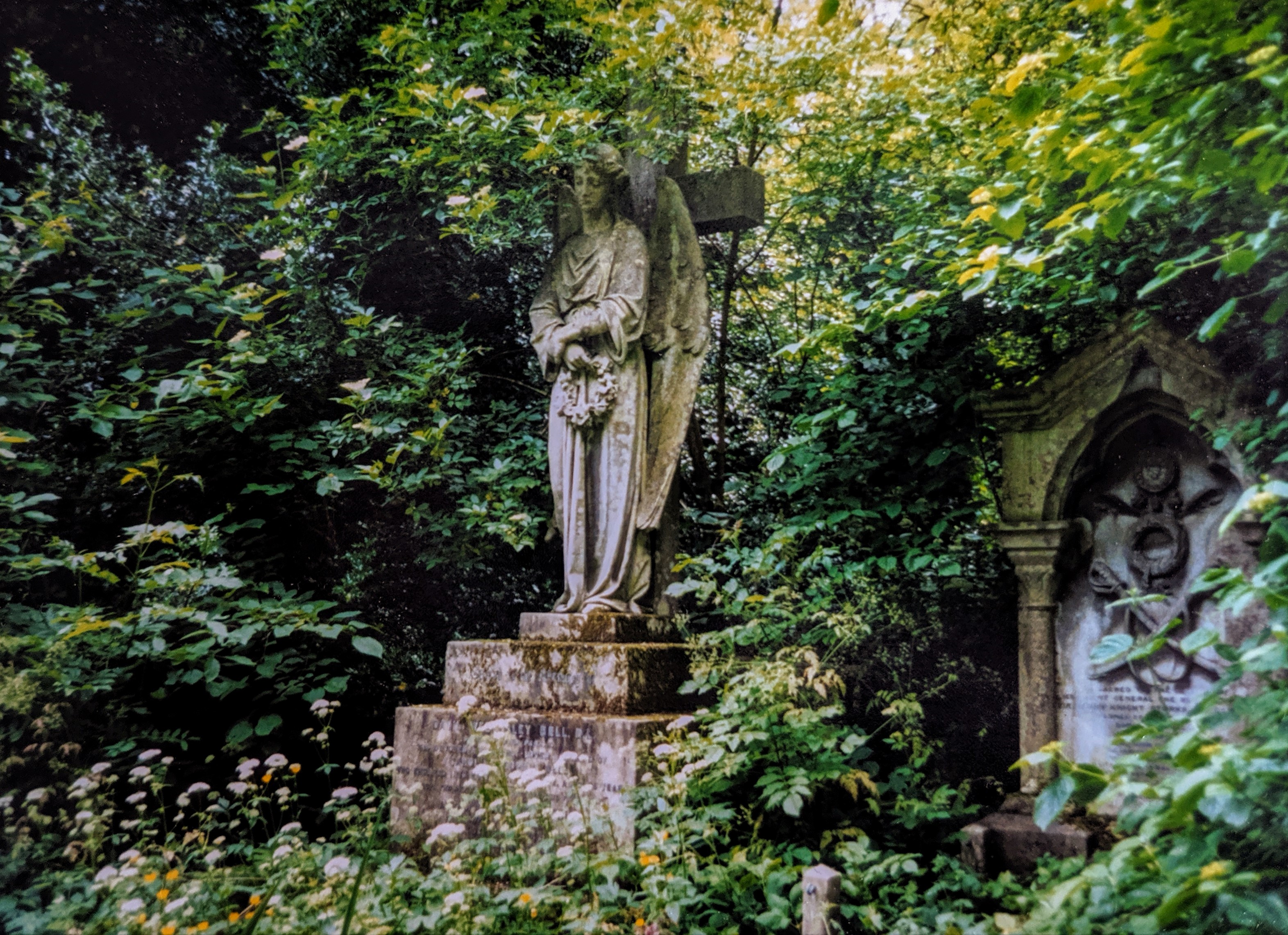
Highgate Cemetery OLD (2)

M R James called them “Ghost Stories”; E F Benson preferred the term “Spook Stories”; H P Lovecraft’s stories were published in the magazine Weird Tales; Robert Aickman called his productions “Strange Stories”. Dave Allen’s 1970s anthology was called A Little Night Reading. Whatever we call them, we know what we are talking about.

The Dave Allen book was in our local library when I was young. I’ve often wished I was in the position to choose the stories for such an anthology myself. Here, then, in no particular order and in time for Halloween, is my selection of ten pretty good ones.

The Monkey’s Paw by W W Jacobs (1902). Three wishes that lead to tragedy. It’s impossible to read the last few words of this tale without that feeling of a shiver up the spine, no matter how many times you have read it before. Be careful what you wish for, in case you get it, indeed.

The Signalman by Charles Dickens (1866). No other form of transport has featured in as many ghost stories as the railway. This is a story of premonition and disaster that Dickens wrote after being involved in a major train crash himself. I’ve looked at it in more detail here.

A Warning to the Curious by M R James (1925). I could have picked any one of half a dozen stories by James, but this one wins out, I think, for the East Anglian coastal setting and the feeling that it is something to do with the recent war. The framing narration makes Seaburgh remote in time as well as place, then the second narrator introduces a note of melancholy, as he casually mentions his dead friend. Nowhere else is the characteristic James atmosphere so strong, that feeling of the light fading on a deserted beach on a late November afternoon.

The Music of Eric Zann by H P Lovecraft (1922). I am not altogether a fan of Lovecraft. I tend to think of him as a writer I enjoyed in my teenage years, then left behind. All those slug or wormlike monsters! Too easy to dismiss as things that do not exist. This one, though, is quite different. Paris by night and strange violin music coming from the garret at the top of the stairs. . . .what can one see from the window?

A Small Place off the Edgware Road by Graham Greene (1947). The place in question is a cinema. This is very creepy and all it is, really, is a chat between neighbours in cinema seats. It’s an all too believable tale of the incursion of the uncanny into the everyday world that I think may show the influence of Walter de la Mare.

Naboth’s Vineyard by E F Benson (1928). Just as with M R James, I could have picked any one of half a dozen by Benson. In fact, his range was a bit wider than James. Some are very English ghost stories, with clearly recognisable coastal settings, whereas others lean closer to the Lovecraft style. As I have written about Pirates elsewhere, for this selection I’ll go for another favourite. Here is a very satisfying tale of property appropriated and revenge from beyond the grave. It couldn’t happen to a nicer fellow. . . .

Bad Company by Walter de la Mare (1955). De la Mare’s ghost stories are not so well known today. He is a master of doubt and ambiguity, close to the psychological style of Henry James. Again, one is spoilt for choice, but this short tale has stuck in my mind. London by night this time, and a reminder of why it doesn’t pay to look too closely at your fellow passengers on the tube. A strange encounter in the underground, followed by a lonely walk through a cold and deserted city to an empty house.

Man Size in Marble by E Nesbit (1893). Like De la Mare, Edith Nesbit is best-known today as a writer for children. I found this in the same anthology of ghost stories for children as the De la Mare one above. All I can say is, it must have been for children with strong nerves. The idyllic early days of a marriage between two artists, a cottage deep in the countryside. What could go wrong? There is a local legend that once a year, the stone effigies in the nearby church are able to walk. . . on Halloween, of course.

Ringing the Changes by Robert Aickman (1964). We are in East Anglia again, that zone of the uncanny, and this is a sort of zombie story, with elements of what is now known as folk horror. What makes it so fascinating, I think, is the relation of the main story about zombies to the second layer of meaning bubbling away under the surface, about the marriage of an older man to a much younger woman.

‘They’ by Rudyard Kipling (1904). This may be a surprise to those whose image of Kipling comes from The Jungle Book and poems of the army and empire. Many of his stories have a supernatural element, and none more so than this one. When the narrator discovers an ancient house, hidden in the Sussex countryside, he catches fleeting glimpses of children at the windows and in the garden. A blind woman holds the key to the mystery. It is made all the more poignant when you realise it was written after the death of Kipling’s own small daughter, and that the house resembles Bateman’s, Kipling’s Sussex home.

I’m aware that I’ve skipped over the surface a bit here, but my intention is to whet your appetite. All these stories have hidden depths that will repay repeated readings. Perhaps the secret of a really good story of this type is that it can be given more than one interpretation.  There are many others. Which ones would you choose?