100 Poems by 100 Poets

What a great idea this is, 100 Poems by 100 Poets, an anthology published in 1986. The earliest poet is John Skelton (b1460) and the latest Sylvia Plath (b1932) but the poems are arranged alphabetically by the poet’s name, so the older ones are mixed in with the more modern, the British with the American.

For those new to reading poems, it’s a great introduction to some wonderful poetry, a slender volume that’s more accessible in every way than some bulkier anthologies. It was compiled by Harold Pinter, Anthony Astbury and Geoffrey Godbert. Their criteria for inclusion were that the poem should have been written in English, no living poets would be included and that the poem selected should be representative of the poet’s work as a whole.

For those more familiar with poetry, some of the choices, both of poet and poem, may be surprising, but an exercise like this was not intended to be definitive nor could it be. It’s rather reminiscent of those list programmes that used to be on the television, a good starting point for a discussion. Every poetry enthusiast could make their own choice and each would be equally valid.

I myself would choose different poems to represent A E Housman, Thomas Hardy, Rudyard Kipling and Louis Macneice than the ones here, but that sort of proves my point. I think on the whole it is a bit of a case of “right poet, wrong poem”. Everyone will find one of their favourite poets missing. For me, Walter de la Mare is a serious omission.

Perhaps the best thing is the inclusion of some poems by poets who are known for just one or two poems today, such as “Adieu, Farewell Earth’s Bliss” by Thomas Nashe, “Madam Life’s A Piece in Bloom” by W E Henley and “The Latest Decalogue” by Arthur Hugh Clough.

In fact, this was one of the books that started me on my poetic journey. I would not be able to make these judgments today if this book had not pointed me in the right direction years ago. In fact, I might not be writing this piece at all if I had not come across this book.

If you want to start reading poetry, and are looking for a guide to some of the best written in English over the last 500 years or so, then this book is a very good place to begin.

I’m still working on my own list!

There is one strange and haunting poem included here that I’ve not come across anywhere else, so here it is.

Let it Go by William Empson (1906-1984)

It is this deep blankness is the real thing strange.
   The more things happen to you the more you can’t
      Tell or remember even what they were.

The contradictions cover such a range.
   The talk would talk and go so far aslant.
     You don’t want madhouse and the whole thing there.

Deer by John Drinkwater

It feels like it happened to someone else now, but just before the lockdown started I had a temporary job. To get there, I took a train down a rural railway line, a sort of reverse commute, if you like, going away from town.

I was sitting in a modern electric train yet passing through countryside that couldn’t have changed too much since the line was built over one hundred years ago.

Every morning in the pale March sunshine, I saw scenes that reminded me of the paintings of Eric Ravilious. Where was that rusting water tank on a muddy track? Where exactly was that row of ancient cottages, or those fields accessible only by footpath? I made a mental note to look on the map and visit them one day.

I saw kestrels and buzzards flying over fields that were full of rabbits and pheasants. There were sheep, horses and, to my great surprise, deer. Did someone own these creatures, or were they wild? One evening, I saw a lone deer exploring the woods on the bank of a narrow river, and I decided they must be wild.

That brings me rather neatly to the poem below. John Drinkwater (1882-1937) was one of the group of poets who lived in or visited the Gloucestershire village of Dymock in the years just before the first world war. Others included Rupert Brooke and Edward Thomas. I don’t know exactly when this poem was written, but it does capture rather well what I felt when I saw the deer.


Deer by John Drinkwater  

Shy in their herding dwell the fallow deer.
They are spirits of wild sense. Nobody near
Comes upon their pastures. There a life they live,
Of sufficient beauty, phantom, fugitive,
Treading as in jungles free leopards do,
Printless as evelight, instant as dew.
The great kine* are patient, and home-coming sheep
Know our bidding. The fallow deer keep
Delicate and far their counsels wild,
Never to be folded reconciled
To the spoiling hand as the poor flocks are;
Lightfoot, and swift, and unfamiliar,
These you may not hinder, unconfined
Beautiful flocks of the mind.


*old word for cattle


Madam Life’s a Piece in Bloom by W E Henley

I have to apologise for the lack of posts recently. I’ve been in hospital having some rather serious surgery. Face masks all round, no visitors,  and Covid swab tests; it’s hardly surprising that the poem below popped into my mind. W E Henley wrote this in 1877. His Invictus is probably better known today, but I prefer this one. After all, we’ve all been trying to avoid meeting the ruffian on the stair recently, haven’t we.


Madam Life’s a Piece in Bloom by W E Henley

Madam Life’s a piece in bloom
Death goes dogging everywhere:
She’s the tenant of the room,
He’s the ruffian on the stair.

You shall see her as a friend,
You shall bilk him once or twice;
But he’ll trap you in the end,
And he’ll stick you for her price.

With his kneebones at your chest,
And his knuckles in your throat,
You would reason — plead — protest!
Clutching at her petticoat;

But she’s heard it all before,
Well she knows you’ve had your fun,
Gingerly she gains the door,
And your little job is done.


Battle of Britain by C Day Lewis

DSCF3223 (2)

The skies over South East England have been quieter and emptier than we are used to of late. Eighty years ago they were full of warplanes as the Battle of Britain began.

This poem was written in 1970 by the then poet laureate, Cecil Day Lewis, for the thirtieth anniversary.

The big-budget cinematic re-enactment of the battle was released around that time, and if my memory is correct, this poem was printed in the programme for the film.

I like the way the narrator of the poem is a witness to the real events, speaking to someone younger for whom they are history. It deserves to be better known, I think.


Battle of Britain by C Day Lewis

What did we earth-bound make of it? A tangle
Of vapour trails, a vertiginously high
Swarming of midges, at most a fiery angel
Hurled out of heaven, was all we could descry.

How could we know the agony and pride
That scrawled those fading signatures up there,
And the cool expertise of those who died
Or lived through that delirium of the air?

Grounded on history now, we re-enact
Such lives, such deaths. Time, laughing out of court
The newspaper heroics and the faked
Statistics, leaves us only to record

What was, what might have been: fighter and bomber,
The tilting sky, tense moves and counterings;
Those who outlived that legendary summer;
Those who went down, its sunlight on their wings.

And you, unborn then, what will you make of it—
This shadow-play of battles long ago?
Be sure of this: they pushed to the uttermost limit
Their luck, skill, nerve. And they were young like you.


Ha’nacker Mill by Hilaire Belloc

I knew who Belloc was, but I did not know much about him. One of the giants of Edwardian writing and friend of G K Chesterton. I was familiar with Cautionary Tales for Children, of course, perhaps his most famous work today. And then there is that poem The South Country, with its repeated references to “the men who were boys when I was a boy”.

But it wasn’t until I saw a television programme about writers in Sussex that I began to realise the depth of Belloc’s attachment to the Sussex countryside over many years.

That led me to the poem below, from 1923. The ruined windmill and the desolate field suggest the end of a rural way of life that was coming to a close at that time. It’s a lament, really, and a poem that needs to be heard to get the full effect.


Ha’nacker Mill by Hilaire Belloc 

Sally is gone that was so kindly,
Sally is gone from Ha’nacker Hill.
And the Briar grows ever since then so blindly
And ever since then the clapper is still. . .
And the sweeps have fallen from Ha’nacker Mill.

Ha’nacker Hill is in Desolation:
Ruin a-top and a field unploughed.
And Spirits that call on a fallen nation,
Spirits that loved her calling aloud,
Spirits abroad in a windy cloud.

Spirits that call and no one answers;
Ha’nacker’s down and England’s done.
Wind and Thistle for pipe and dancers,
And never a ploughman under the Sun.
Never a ploughman. Never a one.


The Belfry by Laurence Binyon

Like most people, I suppose, I knew Laurence Binyon for the famous lines from his 1914 poem For the Fallen: “They shall grow not old, as we that are left grow old/Age shall not weary them, nor the years condemn/At the going down of the sun and in the morning/We will remember them.”

The poem below is in a rather different vein and is completely new to me. I found it in Walter de la Mare’s wonderful anthology Come Hither, which has been a source of inspiration to me for some time now, as it’s full of exactly the sort of poetry I like. The Belfry is rather reminiscent of the style of de la Mare’s own poetry, I feel. It really comes to life if you read it aloud. I don’t know exactly when it was written.

I think it also appeals to me, partly because I too had the childhood experience of climbing up inside an ancient church tower.


The Belfry

Dark is the stair, and humid the old walls
Wherein it winds, on worn stones, up the tower.
Only by loophole chinks at intervals
Pierces the late glow of this August hour.

Two truant children climb the stairway dark,
With joined hands, half in glee and half in fear,
The boy mounts brisk, the girl hangs back to hark
If the gruff sexton their light footstep hear.

Dazzled at last they gain the belfry-room.
Barred rays through shutters hover across the floor
Dancing in dust; so fresh they come from gloom
That breathless they pause wondering at the door.

How hushed it is! What smell of timbers old
From cobwebbed beams! The warm light here and there
Edging a darkness, sleeps in pools of gold,
Or weaves fantastic shadows through the air.

How motionless the huge bell! Straight and stiff,
Ropes through the floor rise to the rafters dim.
The shadowy round of metal hangs, as if
No force could ever lift its gleamy rim.

A child’s awe, a child’s wonder, who shall trace
What dumb thoughts on its waxen softness write
In such a spell-brimmed, time-forgotten place,
Bright in that strangeness of approaching night?

As these two gaze, their fingers tighter press;
For suddenly the slow bell upward heaves
Its vast mouth, the cords quiver at the stress,
And ere the heart prepare, the ear receives

Full on its delicate sense the plangent stroke
Of violent, iron, reverberating sound.
As if the tower in all its stones awoke,
Deep echoes tremble, again in clangour drowned,

That starts without a whir of frighted wings
And holds these young hearts shaken, hushed, and thrilled,
Like frail reeds in a rushing stream, like strings
Of music, or like trees with tempest filled,

And rolls in wide waves out o’er the lone land,
Tone following tone toward the far-setting sun,
Till where in fields long-shadowed reapers stand
Bowed heads look up, and lo, the day is done. . . .


The Coombe by Edward Thomas

I don’t know what brought this one to mind again; perhaps walking in the woods, as I have done so often recently, listening to the birds singing. It’s one of Edward Thomas’ earliest poems, from 1914, I believe.


The Coombe

The Combe was ever dark, ancient and dark.
Its mouth is stopped with bramble, thorn, and briar;
And no one scrambles over the sliding chalk
By beech and yew and perishing juniper
Down the half precipices of its sides, with roots
And rabbit holes for steps. The sun of Winter,
The moon of Summer, and all the singing birds
Except the missel-thrush that loves juniper,
Are quite shut out. But far more ancient and dark
The Combe looks since they killed the badger there,
Dug him out and gave him to the hounds,
That most ancient Briton of English beasts.


The Way Through the Woods by Rudyard Kipling


DSCF3190 (2)


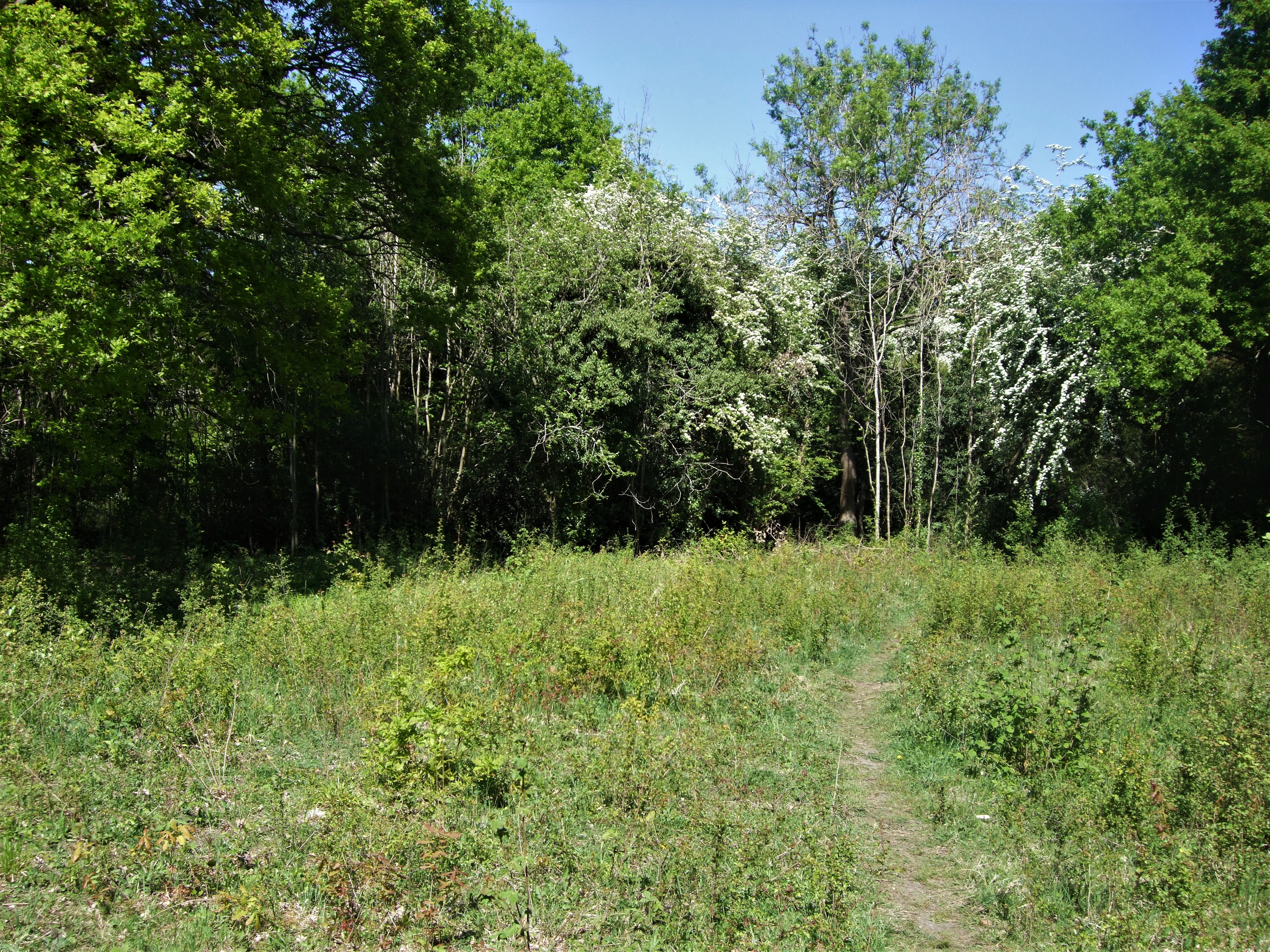
I’m lucky enough to live within ten minutes’ walk of some woods that I’ve known since I was a boy. It’s been a life saver to be able to go there during the lockdown. The place has been transformed, with no planes overhead and much less traffic noise.

Everything smells fresh and the birds all sing at the same time so it’s hard to tell the calls apart. Today we went a little further off the beaten track and surprised a bird in a hole in a tree trunk.

So many trees have grown up since I first knew the place. It’s a nature reserve now and allowed to run wild. It’s hard to pick out the features I knew so long ago and the paths seem to lead in different directions from how I remember them. I found the sunken field with a concrete retaining wall, where they used to race bicycles. It’s completely overgrown now.

As I wander the paths, trying to orientate myself, the opening words of Kipling’s poem come into my mind.


The Way Through the Woods

They shut the road through the woods
Seventy years ago.
Weather and rain have undone it again,
And now you would never know
There was once a road through the woods
Before they planted the trees.
It is underneath the coppice and heath,
And the thin anemones.
Only the keeper sees
That, where the ring-dove broods,
And the badgers roll at ease,
There was once a road through the woods.

Yet, if you enter the woods
Of a summer evening late,
When the night-air cools on the trout-ringed pools
Where the otter whistles his mate,
(They fear not men in the woods,
Because they see so few.)
You will hear the beat of a horse’s feet,
And the swish of a skirt in the dew,
Steadily cantering through
The misty solitudes,
As though they perfectly knew
The old lost road through the woods.
But there is no road through the woods.


On A Return From Egypt by Keith Douglas

For obvious reasons, the celebrations for the 75th anniversary of VE day were a rather muted affair. It was a bit sad that the Red Arrows flypast became an event for television, rather than for real-life spectators.

One small gem did go ahead, though, the broadcast last night on Radio 3 of the play Unicorns, Almost by the poet Owen Sheers. It is a one-man piece about the second world war poet, Keith Douglas, played by Dan Krikler.

All the major poems, such as “How to Kill” and “Vergissmeinnicht” were included. If my memory is correct, the main biographical source was Douglas’s wartime memoir Alamein to Zem-Zem, with the words transposed to the present tense.

This had the effect of bringing Keith Douglas vividly to life, on the battlefield and in Alexandria, rather than leaving him as a figure dead on the pages of a history book.

The device of having Douglas speak after his death was very effective. It enabled Sheers to include the anecdote about Douglas’ mother finding all six copies of his Collected Poems unsold and unopened in her local bookshop, ten years after it had been published.

His reputation has risen slowly and steadily since then. References to his work crop up now and again. Alan Judd used a quote from Keith Douglas as the title for his novel A Breed of Heroes, and he appears as a character in Iain Gale’s novel Alamein.

Keith Douglas survived the battle of Alamein but was killed in action three days after D-Day. He was twenty-four years old.

The following poem was written in England before D-Day and published after his death.


On A Return From Egypt

To stand here in the wings of Europe
disheartened, I have come away
from the sick land where in the sun lay
the gentle sloe-eyed murderers
of themselves, exquisites under a curse;
here to exercise my depleted fury.

For the heart is a coal, growing colder
when jewelled cerulean seas change
into grey rocks, grey water-fringe,
sea and sky altering like a cloth
till colour and sheen are gone both:
cold is an opiate of the soldier.

And all my endeavours are unlucky explorers
come back, abandoning the expedition;
the specimens, the lilies of ambition
still spring in their climate, still unpicked:
but time, time is all I lacked
to find them, as the great collectors before me.

The next month, then, there is a window
and with a crash I’ll split the glass.
Behind it stands one I must kiss,
person of love or death
a person or a wraith,
I fear what I shall find.


A Wet Night by Thomas Hardy

In these difficult times, here is a timely poetic reminder from Thomas Hardy, that those who came before us had to endure far worse and did so with stoicism.


I pace along, the rain-shafts riddling me,
Mile after mile out by the moorland way,
And up the hill, and through the ewe-leaze gray
Into the lane, and round the corner tree;

Where, as my clothing clams me, mire-bestarred,
And the enfeebled light dies out of day,
Leaving the liquid shades to reign, I say,
“This is a hardship to be calendared!”

Yet sires of mine now perished and forgot,
When worse beset, ere roads were shapen here,
And night and storm were foes indeed to fear,
Times numberless have trudged across this spot
In sturdy muteness on their strenuous lot,
And taking all such toils as trifles mere.