An Evening’s Entertainment by M R James

An Evening’s Entertainment is one of the less well-known ghost stories by M R James. It appeared in his 1925 collection A Warning to the Curious and Other Stories. The main character in a James story is often a fusty academic type, a sort of exaggerated version of himself. That is the general image of his work, but it obscures the fact that the range of characters and settings in his stories is actually rather wider than that.

Here, a James-style narrator opens the story and laments the fact that the old story books are not very specific about ghosts or folklore. He then goes on to imagine how a grandmother might tell a spooky story to the grandchildren in front of the fire before bed, hence the title. The story is indeed, in a phrase that appears early on, “a pleasing terror”.

One of the children has picked blackberries from a lane that the grandmother was told to avoid by her grandmother. Why is there a clump of fruit bushes in the lane? Because there was a cottage there once, which was the site of strange goings-on. It was inhabited by a man who didn’t work and didn’t mix much in the village. One day he brought an odd young man back to live with him. The pair were often seen out and about at all hours in the woods and on the downs above the village.

On the downs there is a human figure carved into the landscape, and many ancient burial mounds. Something the young man lets slip in a conversation suggests that on their nocturnal jaunts there, this unlikely pair are not alone. They seem to be familiar with the appearance of the people who lived there before the Romans.

This is just the beginning of a series of gruesome events, involving pagan worship, violent death, burial at a crossroads and the “lord of flies”, events long remembered in the village giving the patch of ground in the lane its bad reputation.

There are only two carved human figures in England, the Long Man of Wilmington in Sussex and the Cerne Abbas Giant in Dorset. I wonder which one James had in mind? Something about this story suggests Sussex to me, perhaps the fact that the figure is referred to as “the old man on the hill”.

James wrote in the preface to his collected ghost stories that he had tried to make his ghosts “act in ways not inconsistent with the rules of folklore”. This particular story is almost the definitive expression of what has come to be known as “folk horror”. It shows, like many of his other tales, that James was particularly skilled at evoking the feel of the English landscape. It rather reminds me of John Masefield’s poem Up on the Downs. I also wonder whether it might have been an influence on Jocelyn Brooke and The Image of a Drawn Sword.  
The Temple by E F Benson

The Temple by E F Benson was published in a magazine in 1924, and later collected in the volume Spook Stories in 1928. It begins, as so often with Benson, with two youngish, well-off bachelors deciding to take an extended holiday in a pleasant part of the country. It is Cornwall this time, and the two men are soon installed in a large seaside hotel, with its own golf links between the beach and the hotel grounds.

The narrator is a writer and his companion is an archaeologist who plans to investigate some of the antiquities of the county. The local people are superstitious about a nearby stone circle, believing it to be a pagan temple. The archaeologist says it can’t be, because the arrangement of the stones is wrong, but more importantly, it lacks a sacrificial stone in the centre. He is sure there must be a temple site somewhere in the neighbourhood and he is determined to find it.

Later, the two men are aware of an ominous atmosphere while walking in a wood: “. . . I was conscious of some gathering oppression of the spirit. It was an uncomfortable place, it seemed thick with unseen presences.” They think nothing of it, emerging back into the sunshine to come across a pretty cottage that appears to be uninhabited. The hotel is beginning to fill up for the season. Would it be possible to stay in the cottage instead? Enquiries are made and the cottage is indeed available at a knock-down price because the previous occupant committed suicide.

The wood on the hill overlooks the cottage. What are the lights that can be seen moving about in it at night? And just what is the large stone that forms part of the kitchen floor of the cottage?

It turns out that the cottage has been built in the centre of the pagan temple, with disastrous consequences. This is not entirely a surprise to the reader, and as I’ve said before, it’s not really suspense that is the appeal of a Benson story, but the sense of inexorable progress towards a malign fate that cannot be avoided.

He also has a wonderful gift for conveying the sense of place in his elegant, precise prose. His stories are often set in a remote part of the English countryside, with a local large town, such as Hastings, often given its real name but the village or hamlet where the action takes place given a fictional name, allowing Benson some room for invention.

The Temple fits neatly into the genre that is today known as Folk Horror. The central idea is also not as far-fetched as it might appear. After all, something similar happened at Avebury in Wiltshire, where the stones of the circle were knocked down in the eighteenth century and used to build houses in the village that grew up inside it. I suspect Benson might have been inspired by the restoration at Avebury that was beginning at around the time he wrote his story.

I’ve also written about Pirates, another tale by Benson.

Ten of the best ghost stories

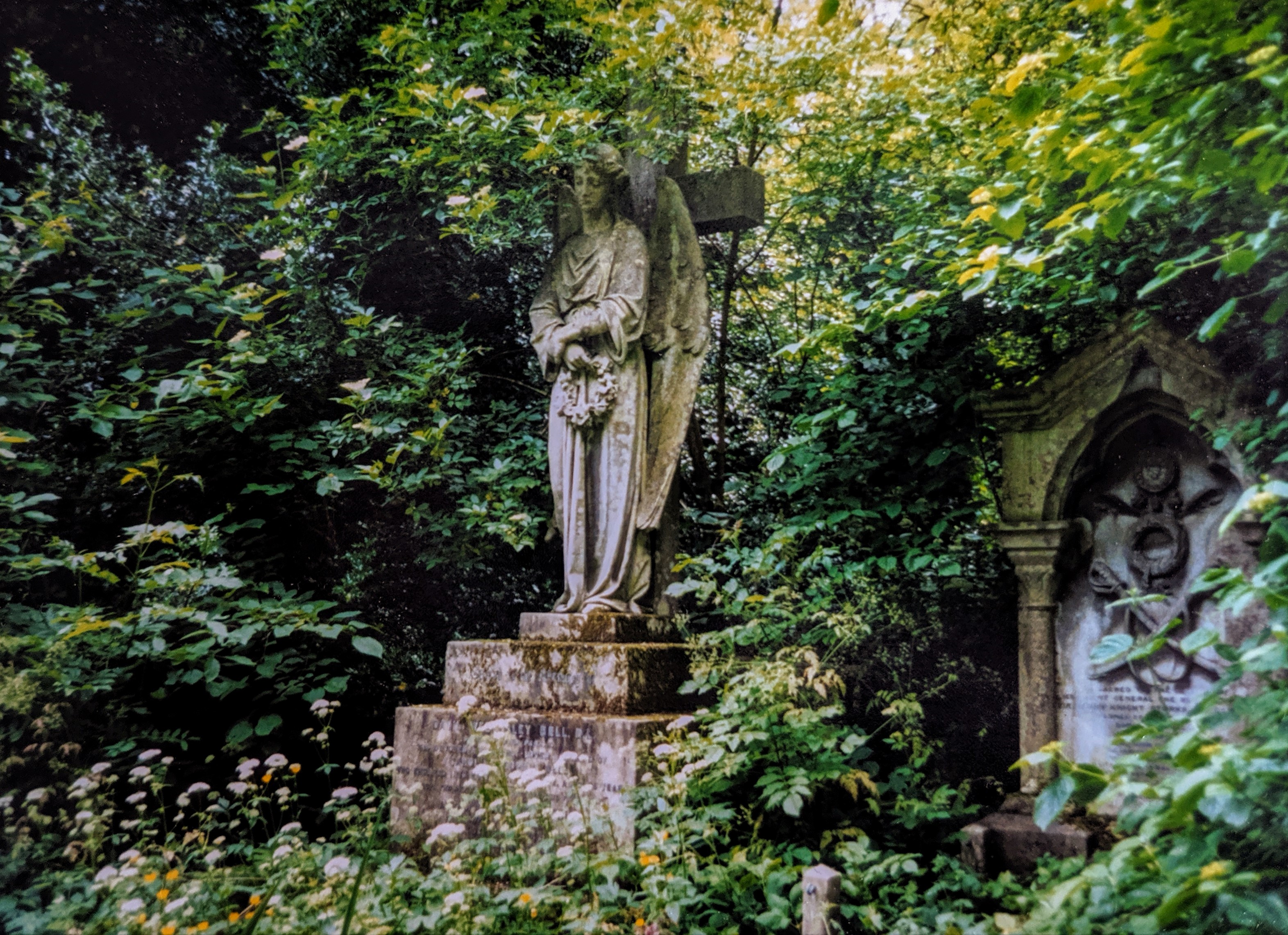
Highgate Cemetery OLD (2)

M R James called them “Ghost Stories”; E F Benson preferred the term “Spook Stories”; H P Lovecraft’s stories were published in the magazine Weird Tales; Robert Aickman called his productions “Strange Stories”. Dave Allen’s 1970s anthology was called A Little Night Reading. Whatever we call them, we know what we are talking about.

The Dave Allen book was in our local library when I was young. I’ve often wished I was in the position to choose the stories for such an anthology myself. Here, then, in no particular order and in time for Halloween, is my selection of ten pretty good ones.

The Monkey’s Paw by W W Jacobs (1902). Three wishes that lead to tragedy. It’s impossible to read the last few words of this tale without that feeling of a shiver up the spine, no matter how many times you have read it before. Be careful what you wish for, in case you get it, indeed.

The Signalman by Charles Dickens (1866). No other form of transport has featured in as many ghost stories as the railway. This is a story of premonition and disaster that Dickens wrote after being involved in a major train crash himself. I’ve looked at it in more detail here.

A Warning to the Curious by M R James (1925). I could have picked any one of half a dozen stories by James, but this one wins out, I think, for the East Anglian coastal setting and the feeling that it is something to do with the recent war. The framing narration makes Seaburgh remote in time as well as place, then the second narrator introduces a note of melancholy, as he casually mentions his dead friend. Nowhere else is the characteristic James atmosphere so strong, that feeling of the light fading on a deserted beach on a late November afternoon.

The Music of Eric Zann by H P Lovecraft (1922). I am not altogether a fan of Lovecraft. I tend to think of him as a writer I enjoyed in my teenage years, then left behind. All those slug or wormlike monsters! Too easy to dismiss as things that do not exist. This one, though, is quite different. Paris by night and strange violin music coming from the garret at the top of the stairs. . . .what can one see from the window?

A Small Place off the Edgware Road by Graham Greene (1947). The place in question is a cinema. This is very creepy and all it is, really, is a chat between neighbours in cinema seats. It’s an all too believable tale of the incursion of the uncanny into the everyday world that I think may show the influence of Walter de la Mare.

Naboth’s Vineyard by E F Benson (1928). Just as with M R James, I could have picked any one of half a dozen by Benson. In fact, his range was a bit wider than James. Some are very English ghost stories, with clearly recognisable coastal settings, whereas others lean closer to the Lovecraft style. As I have written about Pirates elsewhere, for this selection I’ll go for another favourite. Here is a very satisfying tale of property appropriated and revenge from beyond the grave. It couldn’t happen to a nicer fellow. . . .

Bad Company by Walter de la Mare (1955). De la Mare’s ghost stories are not so well known today. He is a master of doubt and ambiguity, close to the psychological style of Henry James. Again, one is spoilt for choice, but this short tale has stuck in my mind. London by night this time, and a reminder of why it doesn’t pay to look too closely at your fellow passengers on the tube. A strange encounter in the underground, followed by a lonely walk through a cold and deserted city to an empty house.

Man Size in Marble by E Nesbit (1893). Like De la Mare, Edith Nesbit is best-known today as a writer for children. I found this in the same anthology of ghost stories for children as the De la Mare one above. All I can say is, it must have been for children with strong nerves. The idyllic early days of a marriage between two artists, a cottage deep in the countryside. What could go wrong? There is a local legend that once a year, the stone effigies in the nearby church are able to walk. . . on Halloween, of course.

Ringing the Changes by Robert Aickman (1964). We are in East Anglia again, that zone of the uncanny, and this is a sort of zombie story, with elements of what is now known as folk horror. What makes it so fascinating, I think, is the relation of the main story about zombies to the second layer of meaning bubbling away under the surface, about the marriage of an older man to a much younger woman.

‘They’ by Rudyard Kipling (1904). This may be a surprise to those whose image of Kipling comes from The Jungle Book and poems of the army and empire. Many of his stories have a supernatural element, and none more so than this one. When the narrator discovers an ancient house, hidden in the Sussex countryside, he catches fleeting glimpses of children at the windows and in the garden. A blind woman holds the key to the mystery. It is made all the more poignant when you realise it was written after the death of Kipling’s own small daughter, and that the house resembles Bateman’s, Kipling’s Sussex home.

I’m aware that I’ve skipped over the surface a bit here, but my intention is to whet your appetite. All these stories have hidden depths that will repay repeated readings. Perhaps the secret of a really good story of this type is that it can be given more than one interpretation.  There are many others. Which ones would you choose?